Where Is Barbed Wire Legal in Houston, TX?
Barbed wire legality in the Houston metro depends on zoning designation and jurisdiction. Understanding the rules before you purchase or install matters significantly because non-compliant installations may require removal at the owner's expense.
Within the City of Houston city limits, barbed wire is permitted on fences in commercial and industrial zoning districts. The Houston Ship Channel corridor, the northwest industrial belt around Highway 290 and West Little York, and the distribution center zones near Beltway 8 all fall into this category. Griffin Fence installs barbed wire extensions for industrial facilities throughout these areas regularly. Residential zones within city limits prohibit barbed wire on fences adjacent to public sidewalks and streets — this is covered under Houston Code of Ordinances Chapter 10.
★5-Star Rated: Griffin Fence maintains a 5-star rating with over 100 verified reviews — every installation backed by a 1-year workmanship warranty.
In unincorporated Harris County, barbed wire is permitted for agricultural and rural residential uses. Landowners in agricultural zones have a broader license to use barbed wire for livestock containment, which is also consistent with Texas Agriculture Code requirements that landowners maintain fencing adequate to prevent livestock from reaching public roads.
In Fort Bend County and Brazoria County suburban areas, ordinances vary by city. Sugar Land, Pearland, and Pasadena each have their own code provisions. Griffin Fence checks local ordinances as part of the estimating process before any barbed wire installation is quoted.
Strand Counts and Extension Arm Configurations
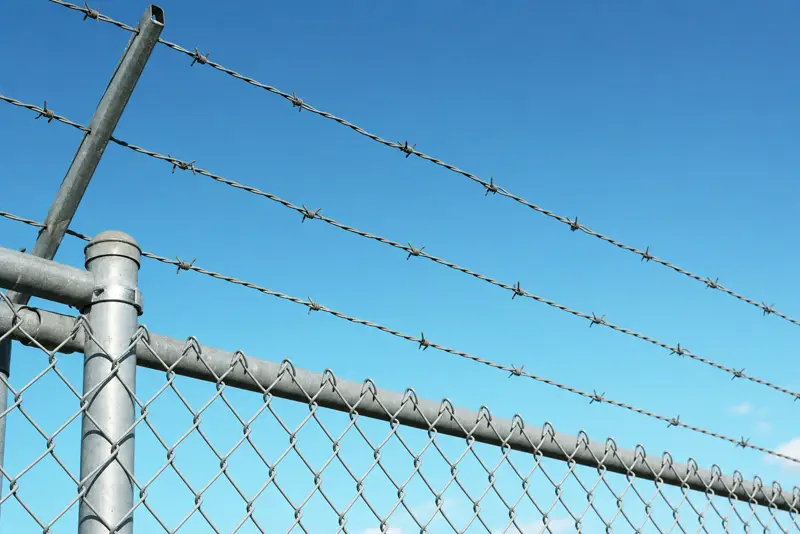
The number of barbed wire strands and the angle of the extension arms determine both the security level and the overall fence height. Standard configurations used in the Houston market include the following:
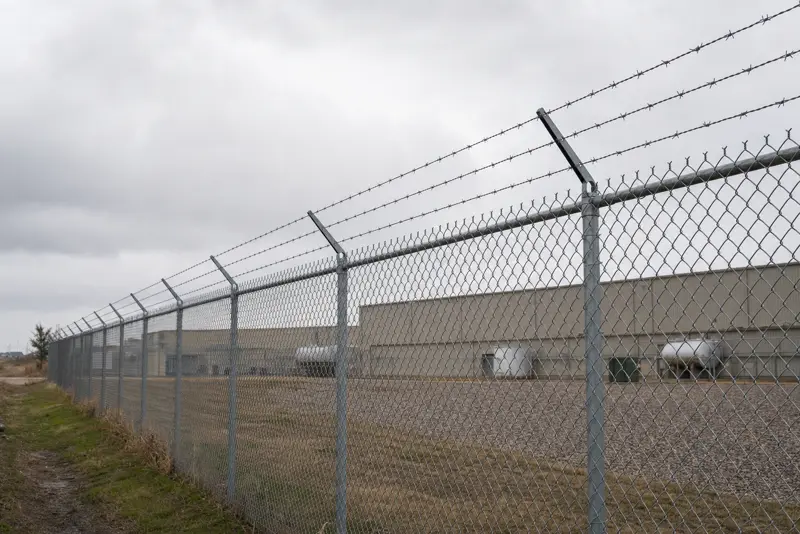
3-strand at 45 degrees outward: This is the baseline commercial security topper. Three strands of barbed wire run on arms angled outward from the top of the fence, adding approximately 12 inches of effective deterrent height above the chain link. This configuration is standard at auto dealerships, contractor storage yards, and distribution warehouses.
⚡Houston Note: Houston’s gumbo clay soil and hurricane wind exposure require deeper post footings and galvanized hardware than national minimums.
5-strand at 45 degrees: More strands mean more wire to navigate and more deterrent effect. Used at higher-value sites including equipment yards, utility substations, and recycling facilities where climb-over attempts are more likely.
Dual-angle or Y-arm configuration: Extension arms that angle both inward and outward simultaneously are sometimes called Y-arms. They put wire on both sides of the fence top and are used at correctional-adjacent facilities and high-security industrial sites.
Razor wire is a separate product from barbed wire — it uses concertina coils of sharp-edged flat tape rather than twisted wire with barbs. Griffin Fence installs razor wire where local code permits, typically only at correctional facilities, utility infrastructure, and high-security industrial sites. Razor wire is not appropriate for standard commercial applications and faces stricter code scrutiny than standard barbed wire.
Barbed Wire vs. Anti-Climb Alternatives
For commercial properties that want intrusion deterrence but cannot use barbed wire — either because of zoning, HOA restrictions, or neighbor proximity concerns — there are effective alternatives.
358 welded mesh (also called anti-climb or prison mesh): This is a welded wire panel with openings too small to provide a finger or toe hold — the openings are 3 inches wide by 0.5 inches tall. It does not cut like barbed wire but is extremely difficult to climb. Often used at schools, parks, and commercial properties in mixed-use areas.
✓Griffin Fence Tip: Griffin Fence has served Houston homeowners since 1979 — over 50,000+ projects completed. Call 713-937-6611 for a free written estimate.
Outward-angled arms without wire: Simply adding the arm extension brackets at the top of a fence creates an overhang that is difficult to get over even without wire. This is sometimes used when barbed wire is prohibited but some deterrence benefit is still desired.
Fence height increase: Going from a 6-foot to an 8-foot chain link fence significantly raises the difficulty of any attempted climb. An 8-foot fence without barbed wire outperforms a 6-foot fence with 3 strands for most opportunistic intrusion scenarios.
Houston Climate and Barbed Wire Maintenance
Houston's coastal humidity — averaging 70 to 80 percent year-round — is one of the most aggressive corrosion environments in the country for unprotected steel. Galvanized wire is not optional in Houston — it is mandatory for any installation expected to last more than a few years. Ungalvanized barbed wire will begin to rust visibly within one season and will structurally degrade within two to three years.
Griffin Fence specifies Class 3 galvanized barbed wire for all Houston installations. Posts, extension arms, and all hardware are also galvanized or coated. In the Ship Channel corridor and southeast Houston near the petrochemical complex, where airborne salt and chemical particulates add to the corrosion environment, post galvanization weight is specified at the heavier end of the range.
⚠Permit Check: Houston city limits don’t require permits for residential fences under 8 ft. Fort Bend County requires permits over 6 ft. HOA approval is separate from city permits.
Barbed wire tension should be checked annually. Houston's temperature swings — from below freezing in rare winter events to over 100°F in summer — cause steel to expand and contract, which can loosen tension wire over time. Loose barbed wire sags, reduces security effectiveness, and can create a hazard if strands drop low enough to contact vehicles or personnel.
Houston Permit Note: Commercial fences and any fence over 8 feet within the City of Houston require a building permit from the Houston Permitting Center (houstonpermittingcenter.org or call 311). Griffin Fence manages permit applications as part of the project scope on commercial work.
For properties that need automated vehicle access alongside the security perimeter, see our chain link fence and gates page or our access control page for gate operator and intercom options.
Additional Barbed Wire Fence FAQs
Is barbed wire legal in Houston residential areas?
No. Barbed wire on fences adjacent to sidewalks and streets in residential zones within the City of Houston city limits is prohibited under Houston ordinance. Barbed wire is permitted in commercial and industrial zones within city limits, and in unincorporated Harris County agricultural and rural residential zones. If you are unsure of your zoning designation, call 311 or visit houstonpermittingcenter.org.
What is the maximum barbed wire height allowed in Texas?
Texas state law does not set a specific maximum height for barbed wire fence Houston, TXs, but the Texas Agriculture Code governs agricultural fence requirements and liability. Local city and county ordinances govern commercial and residential applications within their jurisdiction. In practice, the most common commercial configuration in Houston is 6 to 8 feet of chain link plus 12 to 18 inches of barbed wire extension, for a total of 7 to 9.5 feet. Heights over 8 feet require a permit.
📋Free Estimate Included: Every project starts with a free, in-person estimate. Written quote good for 14 days. No pressure — call 713-937-6611.
Do I need a permit to add barbed wire to an existing chain link fence?
If the addition raises the total fence height over 8 feet, a City of Houston commercial building permit is required. Adding a barbed wire topper to an existing fence in a permitted commercial zone — without changing the overall height past 8 feet — may not require a new permit, but Griffin Fence verifies permit requirements for each job before starting work.
Can I add barbed wire to a fence in an industrial area near residential properties?
This depends on the specific zoning boundaries. Industrial and commercial zones adjacent to residential zones sometimes have buffer requirements. Griffin Fence checks the parcel zoning designation and any applicable buffer or transition rules before quoting barbed wire on any site near residential boundaries.
What gauge chain link is used with barbed wire?
The most common gauge for commercial chain link with barbed wire in Houston is 9 gauge for standard commercial applications and 6 gauge for heavy industrial and high-security perimeters. Lighter 11.5 gauge residential chain link is not appropriate for security applications where barbed wire is also installed — the mesh needs to be heavy enough to resist sustained pressure and cutting attempts.